.png)
In acute care, it is increasingly common for a monitored patient to move between departments without interruption of ECG monitoring. A patient may receive a 12-lead ECG in the emergency department or ICU and later be transferred to x-ray/CT and, when clinically indicated, MRI. Conventional electrodes and connectors that rely on metallic conductive elements can create artifacts and heating risks in strong magnetic fields and may also introduce radiopaque components that complicate radiology workflows. Every time electrodes must be removed and reapplied, hospitals spend additional staff time and consumables, and the patient's skin is exposed to repeated adhesive trauma.
Challenges and Need
A leading international medical device manufacturer asked Premix to support a next-generation, single-use ECG electrode platform that could stay on the patient across both MRI (3T) and radiology workflows. In the first joint technical workshop, Premix and the customer mapped the patient journey and defined four engineering requirements:
-
Excellent MRI compatibility: Minimize image artifacts and avoid local temperature rise in 3T MRI, supporting diagnostic accuracy and patient safety.
-
Radiolucent design for x-ray /CT workflows: Ensure that key conductive and connector components are radiolucent so that patients can undergo x-ray or scanner procedures without electrode change-outs, saving time and cost and reducing skin trauma.
-
Reliable 12-lead ECG performance in daily use: Provide a fast, accurate trace with stable electrical performance during single use, plus mechanical robustness suitable for high-tack adhesives, conductive wet gels, and routine patient movement.
-
Scalable, cost-efficient manufacturing: Support high-yield mass production (e.g., injection molding and hot pressing) on existing production lines.
Solution
Premix led the material selection and early prototyping together with the customer's R&D and manufacturing teams.
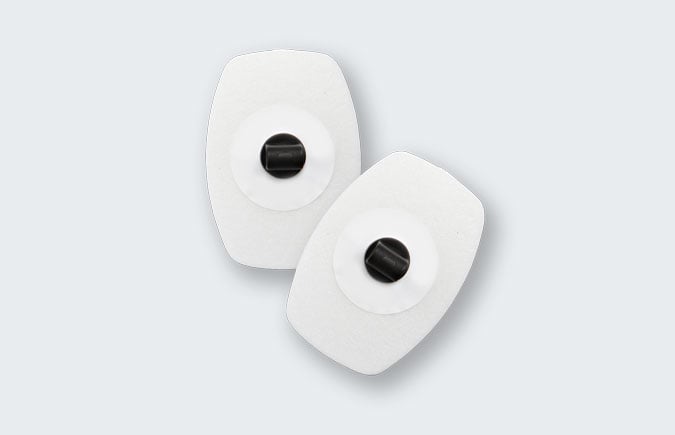
Premix supplied a specialized, highpurity carbon black-filled polypropylene (PP) PRE-ELEC® compound designed for disposable ECG electrode conductive elements and radiolucent connectors.
-
Inherently safe MRI behavior. By replacing metal ·with nonmagnetic conductive carbon black, the conduction path is based on particle-to-particle contacts rather than continuous metallic loops, reducing eddy current effects. In the customer's 3T evaluation setup, prototypes using PRE-ELEC® compound showed improved control of artifact size and temperature rise versus metal-based designs.
-
Imaging-friendly, radiolucent connector design. The electrically conductive compound supports radiolucent connector geometries (including common 4 mm interface designs), enabling the electrode to remain in place during x-ray/CT and scanner procedures and reducing the need for electrode changes between departments.
-
Electrical and mechanical properties tuned for single-use ECG. Premix optimized the compound to deliver stable conductivity and consistent molding behavior while maintaining flexibility suitable for skin-conforming part designs. This supports fast, low-noise traces in 12-lead ECG procedures when combined with the customer's gel and adhesive system.
-
Process advantages for efficient mass production. PRE-ELEC® PP runs on conventional injection molding and hot pressing equipment, helping the customer scale manufacturing with high yield and predictable performance.
"Premix's electrically conductive compounds enabled us to replace metal components in our disposable electrodes and expand compatibility across MRI and radiology workflows. The combination of MRI-safe behavior, radiolucent design possibilities, and robust processing performance was key to a successful launch."
- Customer
Value
Delivered Advances in electrode materials and connector design are helping healthcare providers maintain continuous monitoring as patients move between bedside care and imaging environments. By reducing the need for electrode change-outs, minimizing imaging artifacts, and supporting stable signal transmission, these designs streamline workflow while maintaining trace integrity. Four key considerations define this approach: workflow efficiency and total cost of use, imaging and monitoring confidence, connection reliability, and scalable production flexibility. Together, these factors support uninterrupted patient monitoring across clinical and radiology settings.
-
Workflow efficiency and lower total cost: Fewer electrode change-outs when patients move to x-ray/CT or MRI helps save staff time, reduce consumable usage, and minimize patient handling.
-
Improved imaging and monitoring confidence: Nonmetal conductive elements help minimize MRI artifacts and heating risk, while radiolucent connector options support radiology workflows without interrupting monitoring continuity.
-
Reliability: Stable connector conductivity, together with the customer's electrode design choices (e.g., high-adhesion backings and conductive wet gels), helps reduce time lost to drop-off, and supports accurate 12-lead traces.
-
Scalable production and portfolio flexibility: The customer leveraged existing production assets to introduce an MRI- and radiology-compatible electrode variant alongside other sizes and shapes in their portfolio.
This collaboration demonstrates how Premix pairs conductive polymer expertise with application engineering support to help medical device manufacturers meet increasingly demanding requirements without sacrificing manufacturability or cost targets.
Originally published in Medical Design Briefs, September 2026.
This article was originally published by Medical Design Briefs. Read the original article here.
Read the original article on Medical Design Briefs
Explore more
Materials for Sensors & Wearables
Discover electrically conductive materials for ECG electrodes, wearable sensors, connected health devices, and other next-generation sensor applications.