.png)
Automotive manufacturers engineer vehicles with passenger safety as a top priority. But as vehicles contain more electronics, sensors, advanced driver-assistance systems (ADAS), and electrified components, controlling electrical and electromagnetic risks becomes increasingly important.
Conductive plastics can provide automotive OEMs with an effective alternative to traditional materials while helping to:
- Reduce component weight compared with many traditional metal solutions, supporting vehicle lightweighting initiatives.
- Improve corrosion resistance in applications where metals may be susceptible to moisture, chemicals, or harsh operating environments.
- Increase design flexibility by permitting the easy molding of complex parts.
- Provide EMI shielding to help protect sensitive electronics from electromagnetic interference, including ECU housings, sensors, and electronic modules.
- Control electrostatic discharge (ESD) to reduce the risk of static buildup and sparks in applications such as fuel systems, and to help protect sensitive electronic components during manufacturing, assembly, storage, and transportation.
- Deliver functional conductivity in electrostatic painting processes.
Start with the function
Plastics are insulating by nature. By incorporating conductive fillers, it is possible to create an electrically conductive network within the polymer matrix, enabling the material to have desired electrical properties while still benefiting from the properties of plastics. For automotive designers, this means that the part can be lighter weight, more corrosion resistant, easier to process into complex shapes and offer more design freedom than its metal counterpart.
In many cases, the transition to plastic also means the part needs to be redesigned, not just translated from metal to plastic. Specific set of material requirements should be set up.
EMI shielding for complex automotive electronics
The increasing amount of electronics in vehicles creates new challenges for automotive designers, one of which is electromagnetic interference (EMI). EMI shielding protects devices and people against electromagnetic waves and interference generated by multiple electronic devices, helping prevent signal interference. Historically, EMI shielding has been accomplished with metals.
Potential automotive applications for EMI shielding include ECU and inverter housings, components related to the battery, driver assistance electronics, EV chargers, PCB housings, and other power electronics enclosures. EMI shielding conductive plastic compounds can be a solution in some of these applications.
Shielding effectiveness depends on many factors, including conductive compound formulation, the frequency range, thickness of the part, and the design.
Static electricity management in fuel systems
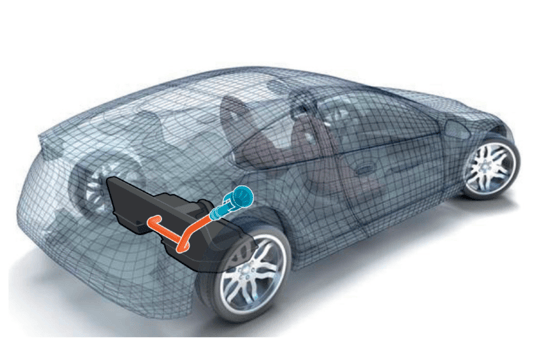
Electrical conductivity can help with direct safety-related applications. When filling up your car with fuel, static electricity can be generated due to friction between the fuel and the inner plastic surface of the fuel system. An example of this is the fuel filler system. Electrically conductive HDPE can be used to discharge the fuel filler heads, necks and pipes. Today's filler pipes are typically multilayer structures, where electrically conductive inner layer is managing static electricity and the other layers provide mechanical properties and barriers. An interesting take-away from this example is that it's not necessarily about replacing the whole structure with electrically conductive plastic. It's about multifunctionality: placing the right function in the right place. The key is selecting the right plastic compound for each layer of the component. The proper material combination helps ensure the part performs as designed while safely dissipating static electricity, reducing the risk of sparks near fuel and helping protect against potential fires or explosions during refueling.
ESD control is also important before electronic components are installed in the vehicle. During manufacturing, assembly, storage, and transportation, sensitive automotive electronics need to be protected against electrostatic discharge. Electrically conductive and static dissipative plastics are used in ESD-safe trays, totes, boxes, and other handling and packaging solutions to help protect components throughout the manufacturing and logistics chain.
Simplifying electrostatic painting
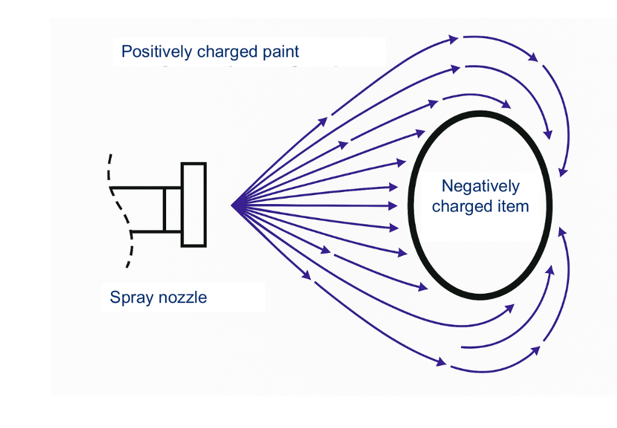
Electrical conductivity can also be utilized for manufacturing and finishing the plastic part. Electrostatic painting is a process where charged paint particles are attracted to grounded parts for an even coating application with little overspray. For this process to work, the part to be coated needs to have enough conductivity. If a non-conductive polymer were used instead, a conductive primer would be needed for electrostatic painting. By using conductive plastic, the conductive primer steps can be eliminated. This opens up the possibility of a shortened process, lower energy use, savings in primer and improved process efficiency, while also reducing the use and handling of chemical primers that may contain hazardous substances. Automotive exterior parts like fuel flaps could be an example of this. Other potential applications are bumpers, mirrors, fenders, spoilers and door handles, depending on the material, surface properties and the component design.
Think multifunctional, not just lightweight
Automotive manufacturers and engineers have a growing opportunity to evaluate components traditionally made from metal and determine where conductive plastics could provide the required electrical performance while reducing weight, cost, and complexity.
The question is no longer, “Can we replace this metal component with plastic?” But instead: “Can we redesign this component using conductive plastics to reduce weight and cost while maintaining safety and performance?”
Four questions provide a good starting point:
- What electrical function is required? Does the component need to dissipate static electricity, provide grounding, deliver EMI shielding, support sensing, or transmit an electrical signal?
- What performance requirements must be maintained? Consider mechanical strength, operating temperatures, chemical exposure, durability, and surface requirements.
- Can the component be redesigned specifically for plastic? Rather than simply reproducing a metal part in plastic, optimizing the geometry for molding can reduce material use, consolidate parts, and improve manufacturability.
- Can the material provide additional functionality? A properly engineered conductive plastic compound may eliminate the requirement for separate components, conductive coatings, primers, or secondary processing steps.
The answers can help to identify where conductive plastics make the most sense.
 |
|
 |
|